The route
What you sail past on the Bosphorus
Palaces, mosques, fortresses and bridges on the Bosphorus, south to north: who built each one, when, and where it stands on the European or Asian shore.
Book a table on the Bosphorus ↗Quick answer
A Bosphorus dinner cruise passes the Maiden's Tower, the Galata Tower, Dolmabahçe Palace, Ortaköy Mosque, two bridges, Beylerbeyi Palace and, on a longer sailing, the Rumeli Fortress. The strait is about 31 kilometres long, and Istanbul stands on both banks. The route and the order change with the departure pier and the weather, so use this guide as a map of the strait.
The strait itself
The Bosphorus is a natural strait that links the Black Sea to the Sea of Marmara and forms one of the boundaries between Europe and Asia. It is about 31 kilometres long, and its width runs from about 700 metres at the narrowest point to more than three kilometres. Istanbul stretches along both banks, which is why a boat on the water has the city on either side of it. The European bank is the one with Galata, Dolmabahçe and Ortaköy, and the Asian bank is the one with Üsküdar and Beylerbeyi.
Maiden's Tower and Galata Tower
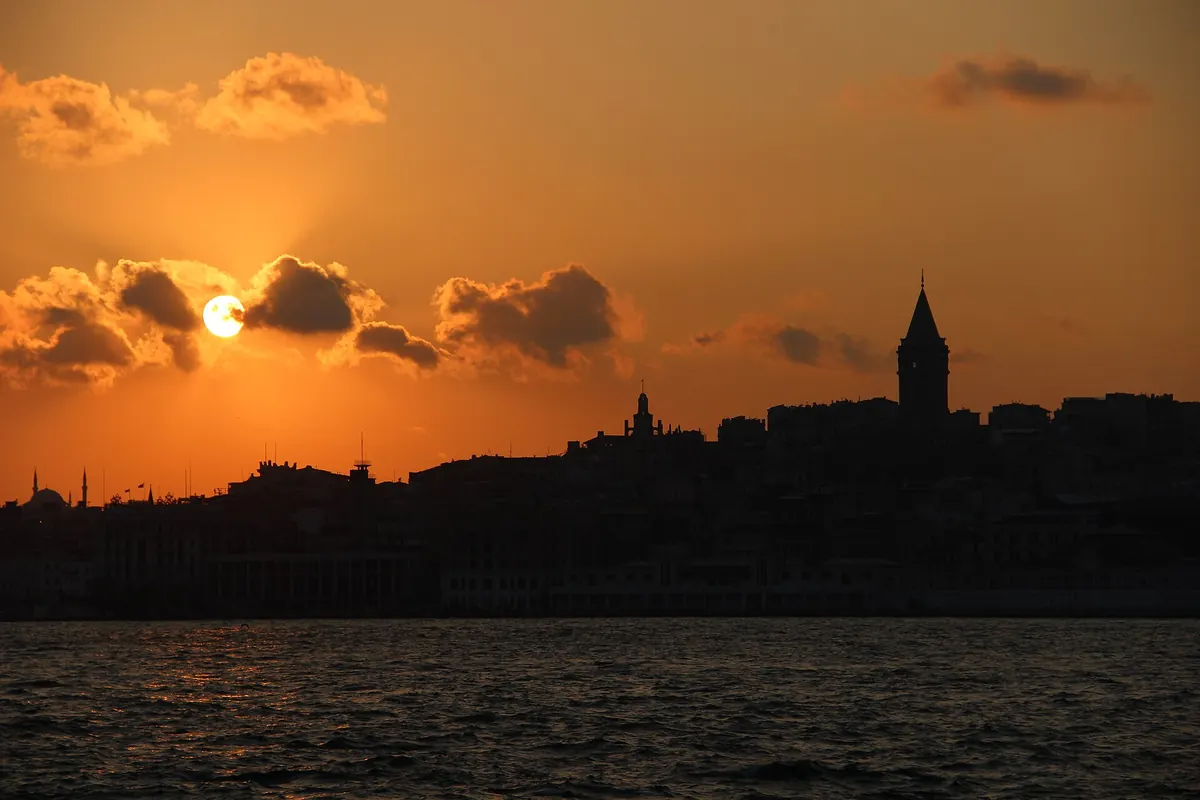
Near the southern end of the strait, Maiden's Tower stands on a small islet about 200 metres off Üsküdar. Emperor Alexios Komnenos had a wooden tower built there in 1110, and the present stone tower dates from 1763. On the European side, the Galata Tower was built in 1348 by the Genoese colony as the Christea Turris, and at the time it was the tallest building in the city. Both are lit at night, and both appear among the landmarks named on the cruise ticket.
Dolmabahçe and Ortaköy
Dolmabahçe Palace was ordered by Sultan Abdülmecid I, and work began in 1843. The palace served as the empire's main administrative centre from 1853 to 1887 and again from 1909 to 1922. A little further north, the Ortaköy Mosque, formally the Büyük Mecidiye Camii, was commissioned by the same sultan and completed around 1854 or 1856. The Armenian architects Garabet and Nikoğos Balyan, a father and son, worked on both. Dolmabahçe mixes Baroque, Rococo and Neoclassical elements with traditional Ottoman planning, and its long frontage faces the water.
The first bridge
The first bridge was finished on 30 October 1973 and runs from Ortaköy on the European side to Beylerbeyi on the Asian side. Its length is 1,560 metres, its main span is 1,074 metres, and it was the first of the strait's three suspension bridges. Since 2016 it has formally been called the 15 July Martyrs Bridge, although many people still call it the First Bridge. It has steel towers, and its deck hangs from steel cables. For anyone on the water, it marks the middle of the strait.
Beylerbeyi Palace
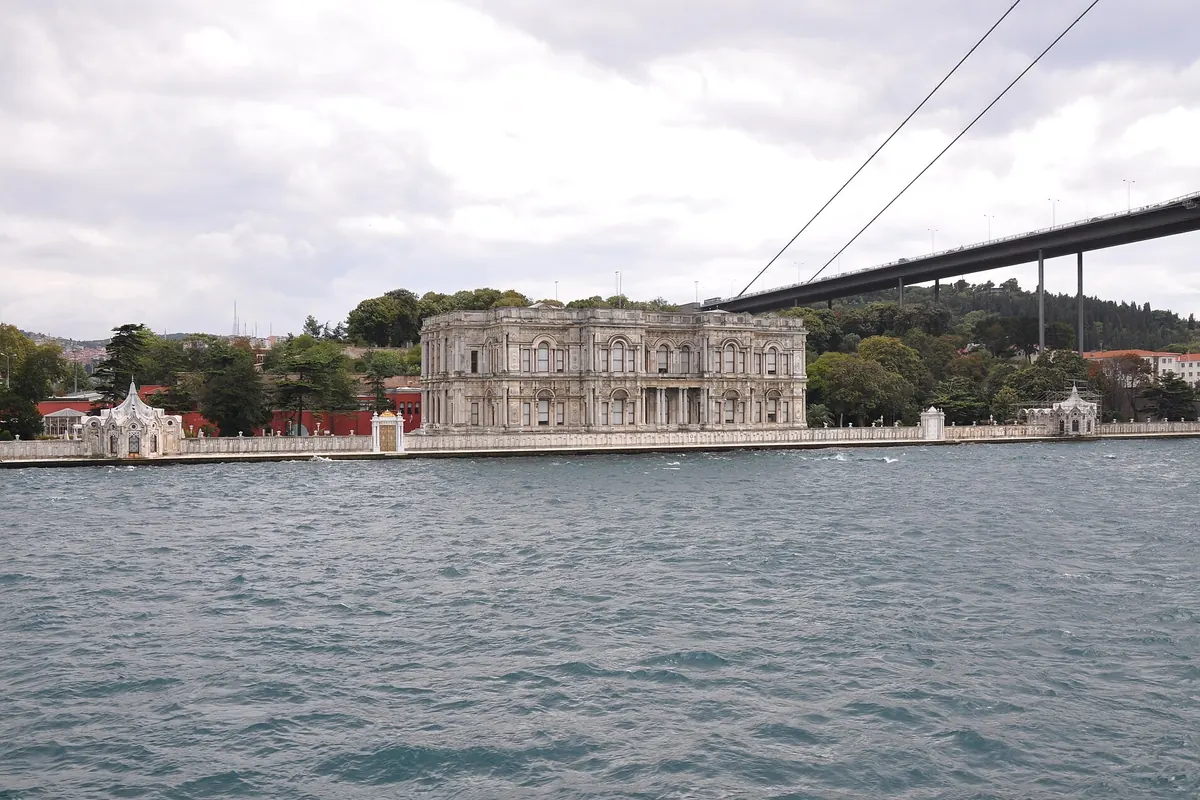
On the Asian shore, at the foot of the first bridge, stands Beylerbeyi Palace. Sultan Abdülaziz had it built as a summer residence and a state guest house, in the 1860s, and it was finished in 1865. Empress Eugénie of France stayed there in 1869, the year of the Suez Canal opening, and other royal guests followed. It faces the strait, and its two bathing pavilions can be seen from the water, which is the view a cruise gives you.
Fortresses and the second bridge
Further north the strait narrows. Rumelihisarı was built in 1451 and 1452 on the order of Mehmed II, ahead of his siege of Constantinople, and its older sister Anadoluhisarı stands on the opposite bank, built in 1393 and 1394 under Bayezid I. The Fatih Sultan Mehmet Bridge, opened in 1988 and named after the same Mehmed, crosses close to the Rumeli Fortress. The ticket names both bridges, and the booking page and the host describe how far your own route runs.
Frequently asked questions
Which side is Europe?
The western bank. Galata, Dolmabahçe, Ortaköy and Rumelihisarı are on the European side, while Üsküdar, Beylerbeyi and Anadoluhisarı are on the Asian side.
How long is the strait?
About 31 kilometres, from the Black Sea to the Sea of Marmara, and between roughly 700 metres and over three kilometres wide.
Do all cruises pass every sight?
No. The route depends on the pier, the boat and the weather. The ticket names the landmarks it passes, and the host describes your own route.
Sources